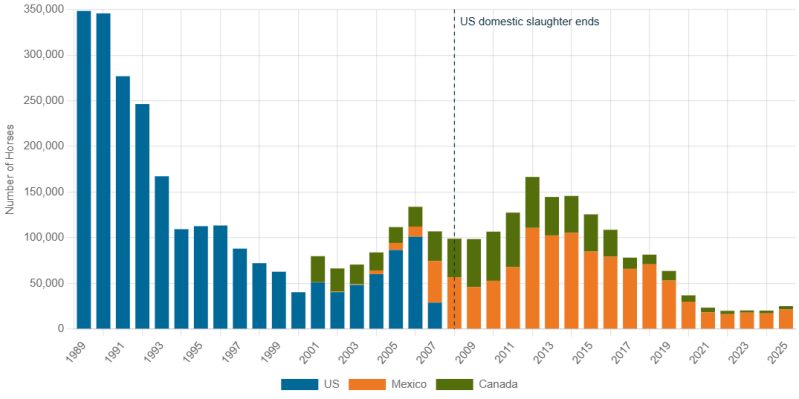
Someone commented on a recent post that we should bring back horse slaughter to the United States because it would "help save animals", presumably believing it would prevent the theft of horses for human consumption. They also said that 40,000 horses per year are stolen, but that "maybe 2,000 of them may have gone to slaughter, and no idea what happened to the rest of them". Upon doing a little research, the 40,000 statistic was from a study done in Texas in the "late 1990's". The attached chart shows horse slaughter statistics from 1989 to 2025. Between 1989 and 2000, the USDA only kept statistics on horse slaughter in the US. In 1989 they reported that 348,400 horses were slaughtered in the US, with an unknown number going to slaughter in Mexico and Canada. In 2007, the last year horse slaughter plants operated in the US, 28,902 horses were slaughtered in the US, and a total of 106,963 America's horses were slaughtered in the US, Mexico and Canada. Just counting the number of horses slaughtered on US soil in 1989 and not factoring horses that were shipped out of the country for slaughter, that's a drop of around 60%. The peak number of horses shipped to slaughter since 2007 was 166,572, and that was in 2012. In 2013, Horse Illustrated reported that approximately 55,000 horses were stolen annually, but not what years that figure was based on. If it was a curent statistic, then are we to assume that one third of horses shipped to slaughter were stolen?
To put things in perspective, a total of 25,128 horses went to slaughter from the US in 2025. Not 300 thousand, not even 100 thousand. Just over 25 thousand. A fraction of the number of horses slaughtered in 1989. (Yes, even one is one too many.) No one really seems to know how many horses are currently stolen on an annual basis, but Animal Welfare Institute's website states that "Hundreds—perhaps thousands—of our horses are stolen each year". Not tens of thousands. Hundreds, MAYBE thousands? AS HORSE SLAUGHTER DECREASES, SO DOES HORSE THEFT. In 1998 a ballot initiative was passed in California banning horse slaughter for human consumption. Horse theft dropped by over 34% in the state.
After the slaughter plants closed in the US in 2007 there was reported to be an increase of horses being abandoned or neglected. But there was also an increase of horses going to slaughter until 2012. Slaughter was still an option for horse owners, and sales barns were obviously still busy. It's highly likely that the increase in abandoned and neglected horses as well as the increase of horses going to slaughter might be in part to the economic recession, which started in 2008. But it can't be ignored that the number of horses shipped to slaughter dropped from 166,572 in 2012 to an average of 21,800 horses shipping over the last five years. That's a drop of almost 145,000 equine per year since 2012.
Horse slaughter is driven not by the need for humane "disposal" of equines, it's driven purely by profit. The ONLY reason for horse slaughter is that there is a demand for horse meat. Whether it's for human consumption in other countries, or for ingredents used in pet food that is sourced from other countries. If suddenly no one ate horses, or ingredients from horses was banned for use in pet food, then what? Would there suddenly be a glut of horses needing homes? The USDA reported that 92.3% of horses arriving at slaughter plants were in "good" condition, meaning they were not underweight, overweight, lame, or sick. If we breakdown the number of horses that ship every year, and multiply it by 92.3%, that give us 20,121 horses that need to be rehomed every year. Seems like a huge amount, unitl you divide by 50 states, and that is about 402 horses per state. Not such a big number, is it. And it's quite realistic to see that the horses that end up slaughtered could easily be absorbed if they were given the chance of being made available to the public. That number would drop further if the mass breeders could no longer profit from sending culls direct to slaughter or breeding specifically for slaughter. There would be no profit in it, and so it would stop (anyone remember what happened to Arabians in the 80's?). Unfortunately too many horses are never given a chance. Far too often horses end up at auction where they are scooped up by kill buyers. Every rescue can tell you about the nicest horses they have gotten from a kill pen. If horse slaughter was no longer an option, kill buyers would either go out of business or some of them would end up working with the horses and selling them. As the stats show, horse slaughter is a dirty, dying industry. It's clear that the demand for horse meat is declining world wide. 80% of Americans oppose horse slaughter, here or anywhere else. We don't eat horses, and bringing horse slaughter back to the US won't change that. And it's not going to keep our horses safer. In fact, it will put them at more risk. Only a few people want horse slaughter here in the US - those who look at everything as a commodity. Current law prohibits the slaughter of dogs and cats for human consumption. H.R. 1661 aka The SAFE Act extends that prohibition to equines (horses, mules, donkeys). There are currently 231 cosponsors. Contact your representative to let them know you support this bill. Don't let less than 20% determine the fate of horses in the US. Chart from Animal Welfare Institute.
Add comment
Comments